Google Ads for Texas lawyers is an auction where the most contested keywords cost more than a day's rent per click. Google Keyword Planner shows advertisers bidding $137.65 to $632.29 at the top of the page for the plain personal injury search in Texas. The same tool shows estate planning at $4.48 to $21.31. Where the money goes depends almost entirely on which practice you sell.
Key Takeaways
- Personal injury is the most expensive practice area to advertise in Texas: $137.65 to $632.29 for a top-of-page click, against $10.69 to $64.67 for divorce and $2.97 to $13.85 for employment (Google Keyword Planner, Texas, pulled October 7, 2026).
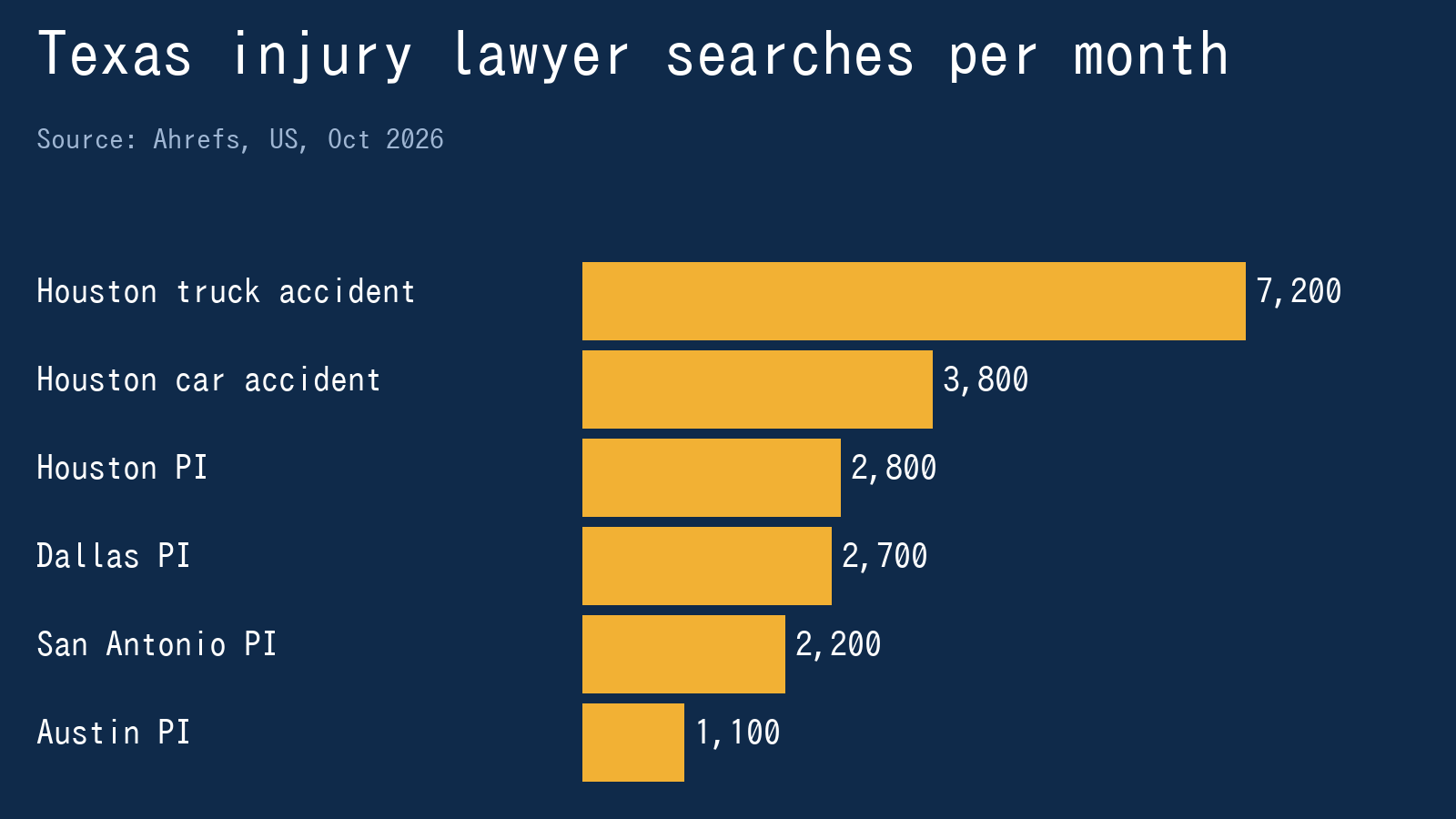
- Ahrefs shows the Houston truck accident search with high volume (7,400 a month) and very low organic difficulty (4), which is where a dedicated page can compete without a bidding war. The Houston car accident term is busier than it is easy: 3,800 a month at difficulty 46 (US database, pulled November 5, 2026).
- Broad injury searches in Houston, Dallas and San Antonio score 62 to 75 on organic difficulty, the same terms most firms bid on. Austin is lower at 35.
- Google says an advertiser often pays less than the stated bid, and that ad and landing page quality affect where an ad lands. A better page lowers the cost of every click you buy.
- Whether a click comes from an ad or a page, Texas Disciplinary Rules 7.01 to 7.06 apply.
What Texas practice areas pay per click
Keyword Planner gives a range for the bid that advertisers pay to appear above the organic results. It is not a quote for your account, and it does not predict what you will pay. It is a market price list. These are the Texas figures from our October 2026 pull.
| Keyword (Texas) | Avg monthly searches | Top-of-page bid, low | Top-of-page bid, high |
|---|---|---|---|
| personal injury lawyer | 22,200 | $137.65 | $632.29 |
| dui lawyer | 12,100 | $19.65 | $200.84 |
| criminal defense attorney | 6,600 | $13.20 | $106.56 |
| family law attorney | 22,200 | $12.82 | $65.19 |
| divorce lawyer | 18,100 | $10.69 | $64.67 |
| immigration lawyer | 14,800 | $10.87 | $35.52 |
| business lawyer | 8,100 | $8.11 | $39.05 |
| estate planning attorney | 27,100 | $4.48 | $21.31 |
| employment lawyer | 12,100 | $2.97 | $13.85 |
Source: Google Keyword Planner, geo Texas, 12-month average monthly searches and top-of-page bid range, pulled October 7, 2026.
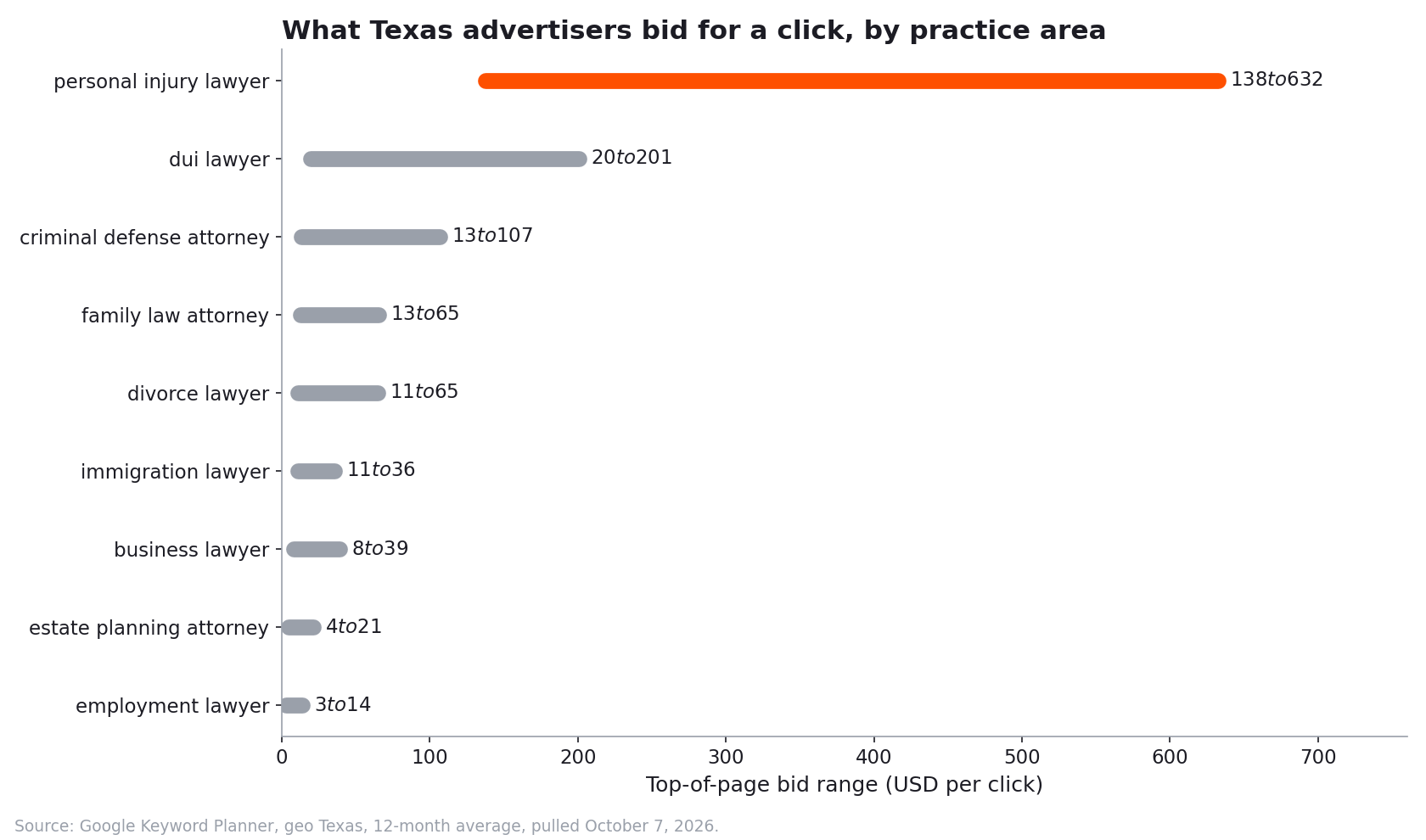
Three patterns stand out. Personal injury is in a class of its own, with a low bid higher than the high bid for employment, estate planning and immigration. Criminal defense and DUI sit in the middle. And volume does not set the price. Estate planning draws the most searches in the table, 27,100 a month, yet has one of the lowest bid ranges.
What an injury click costs a firm
Here is an illustration, not a result from any firm. Suppose a Texas injury practice buys 25 clicks on the plain personal injury search. At the bottom of the range, $137.65, that is $3,441. At the top, $632.29, it is $15,807. Now apply your own numbers. If one click in 20 becomes a call and one call in four signs, 25 clicks produce about 1.25 calls and about 0.3 signed cases. Even if your conversion rate is far better than that, the arithmetic is unforgiving enough that a firm should run it before it sets a budget.
Our law firm marketing budget calculator lets you test different splits between ads, organic work and intake. The planning assumptions behind it are editorial, not survey data, and the page says so.
Where organic search is cheaper to win
Paid search is one auction. Organic search is a different contest, and the two do not price the same keyword the same way. Ahrefs shows the injury terms like this.
| Search phrase | Monthly searches | Organic difficulty (0-100) |
|---|---|---|
| houston truck accident lawyer | 7,400 | 4 |
| houston car accident lawyer | 3,800 | 46 |
| houston personal injury lawyer | 2,800 | 62 |
| dallas personal injury lawyer | 2,700 | 62 |
| san antonio personal injury lawyer | 2,800 | 75 |
| austin personal injury lawyer | 1,300 | 35 |
Source: Ahrefs Keywords Explorer, US database, pulled November 5, 2026.
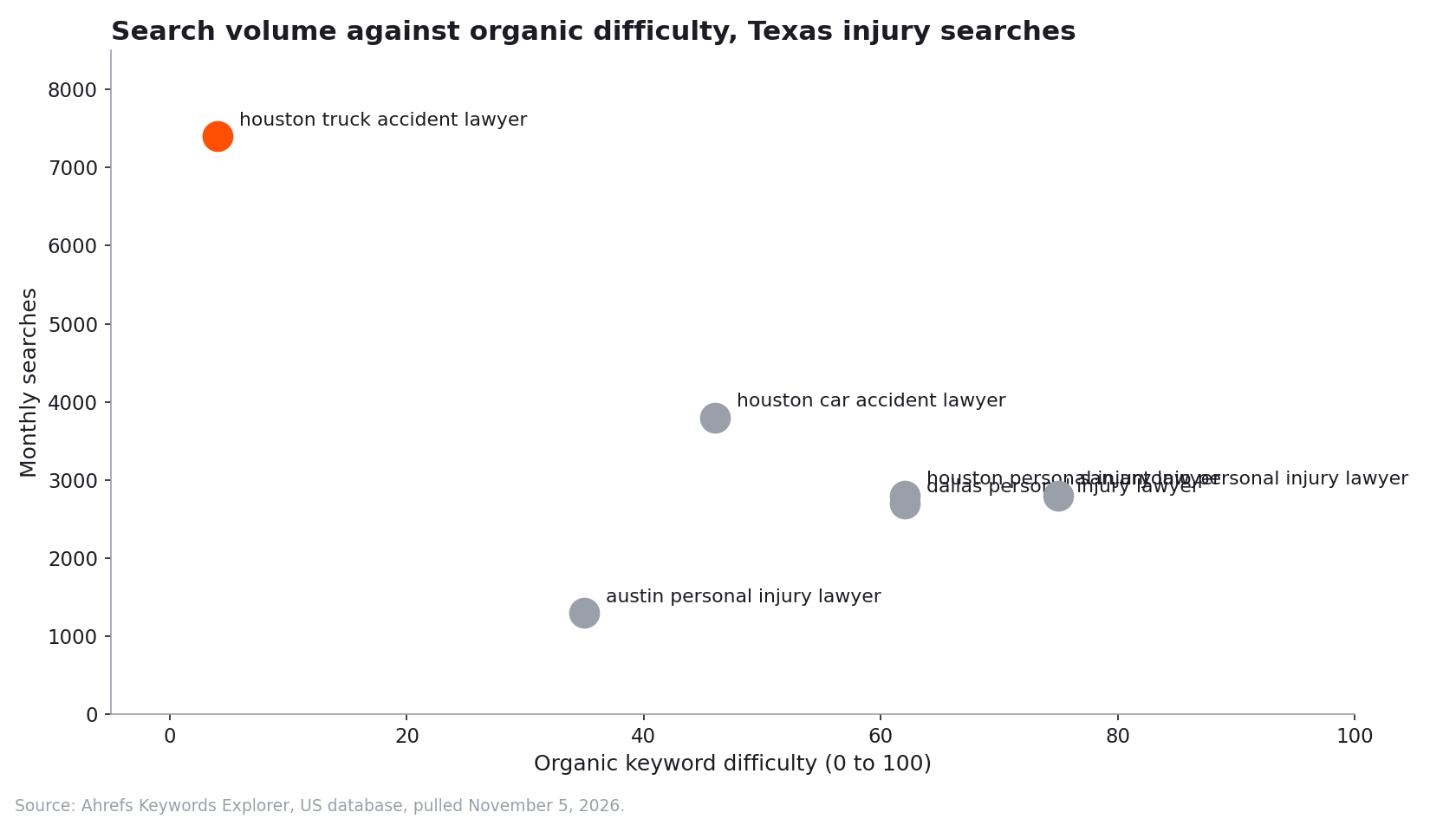
The broad personal injury searches in Houston, Dallas and San Antonio are hard to rank for organically, with difficulty from 62 to 75. They are also the searches most firms bid on, which is part of why the paid price is so high. Austin's broad term scores 35, a softer contest. The vehicle-specific searches split. The Houston truck accident phrase has high volume and a difficulty of only 4, so a dedicated page has a realistic route to the first page. The Houston car accident phrase draws 3,800 searches at difficulty 46, a middle contest that rewards a strong page. Ahrefs also estimates traffic potential for a top page, meaning visits across all the related searches the page could rank for: about 6,700 for the Houston car accident term and about 8,800 for the Houston personal injury term. Those are estimates for a page that reaches the top, not forecasts.
Tool numbers do not always agree. Keyword Planner reports 14,800 average monthly searches for the Houston personal injury term in Texas, while Ahrefs reports 2,800 in the US database on November 5, 2026. Different definitions, different data. Use each tool for what it is good at, and do not add them together. Our Houston personal injury SEO analysis goes through the Planner numbers city by city.
How Google decides what you pay
Many firms assume the highest bidder wins. Google's own documentation says otherwise. Its explanation of how the Google Ads auction works describes the maximum bid, the quality of the ad and landing page, minimum quality thresholds and the context of the search as inputs. It adds that how much you end up paying is often less than your bid.
Quality Score, the 1 to 10 rating shown at keyword level, is a diagnostic. Google's page on Quality Score for Search campaigns says it is not an input in the auction, and that it is built from expected click-through rate, ad relevance and landing page experience. Those three parts are still worth fixing, since they describe how well your ad and page match what a searcher wanted.
For a law firm, the practical lesson is that the landing page is a cost lever. A page that loads quickly, matches the search and shows a lawyer's name and a working phone number can lower what you pay per click while raising what you get from each one. A generic home page does the opposite. Our Texas law firm PPC service starts with the page, not the bid.
Cutting waste before you scale a budget
A high price per click makes small leaks expensive. Four habits do most of the work, and none needs a new tool.
First, track calls by source. A click that never becomes a phone call or a form is a cost with no signal. Use a call tracking number on the landing page and tie form submissions to the campaign that sent them. Second, give each case type its own landing page. A person searching for a truck crash and a person searching for a dog bite want different first paragraphs, and the ad should send each of them to the page that matches.
Third, set the geography on purpose. A Houston firm paying for clicks from outside its service area is subsidizing someone else's market. Fourth, review the search terms report every week and add negative keywords for searches that signal the wrong kind of visitor, such as job seekers and people looking for free forms. This is also where a firm sees how real people phrase the problem, which helps the page copy.
None of this lowers the market price of a click. It does make sure that the clicks you pay for are the ones you wanted, which is the only part of the auction a firm controls.
Where organic search fits
Ads buy visibility this month. Pages build visibility that compounds. For most Texas firms the practical split is a small, tightly targeted ad budget on the highest-value case types, and in parallel a set of city and practice pages built for the specific searches above. We explain the build order in Law Firm SEO in Texas.
A page also keeps working after the budget stops. An ad does not. That difference is the whole argument for doing both, and it is the argument against putting everything into either one.
Advertising rules still apply
Texas Disciplinary Rules 7.01 to 7.06 govern what you may say in an ad or on a page. Claims about results, the word specialist and comparisons to other lawyers need care. The State Bar of Texas Advertising Review page explains how lawyers file advertisements, lists a $100 application fee and describes preapproval, which a lawyer may request by submitting an ad at least 30 days before first use. Read our guide to Texas lawyer advertising rules for websites before launching either channel. This post is marketing information, not legal advice.
Want to know which of these searches your firm already shows up for? Request the free AI Visibility Audit.
Frequently Asked Questions
How much do Texas lawyers pay per click on Google Ads?
It depends on the practice. Google Keyword Planner shows top-of-page bid ranges from $137.65 to $632.29 for personal injury, $10.69 to $64.67 for divorce and $2.97 to $13.85 for employment (Texas, pulled October 7, 2026). What a firm actually pays depends on its own bids, ad quality and competition.
Why is Google Ads so expensive for personal injury lawyers?
Many firms bid on the same few searches, and a signed injury case is worth a lot to a firm that handles one. The auction prices each click against what advertisers are willing to pay. Broad injury searches in Houston, Dallas and San Antonio also score 62 to 75 on organic difficulty in Ahrefs, so there is no cheap organic route to those exact terms.
Are Google Ads worth it for a small law firm?
They can be, when the firm tracks calls by source and knows what a signed case is worth. A small budget aimed at the highest-value case type and a tight geography is easier to learn from than a broad campaign. If the firm cannot track what the clicks produce, hold off until it can.
Should a law firm choose Google Ads or SEO?
Most firms need both in different proportions. Ads can produce calls this month, and organic pages build visibility that compounds. Specific searches with low organic difficulty, such as the Houston truck accident term in Ahrefs, are good early candidates for pages.
Does Google charge the maximum bid for every click?
No. Google's documentation says the amount an advertiser pays is often less than the bid. Ad quality and landing page experience also affect where an ad appears, so a better page can cost less per click than a weaker one at the same bid.
Do Texas advertising rules apply to Google Ads?
Yes. An ad is lawyer advertising under Rules 7.01 to 7.06 of the Texas Disciplinary Rules of Professional Conduct. It must not be misleading or create unjustified expectations about results, and it must identify the responsible lawyer and primary practice location. Ask the responsible lawyer about filing before launch.