OpenAI dots for Texas law firms can support the follow-up work around intake and marketing: organizing an approved queue, preparing internal summaries and surfacing items that need a person. Astra for Law serves a different role in legal research and analysis for eligible users. Connect the two through a deliberate staff handoff, with a lawyer responsible for any legal assessment.
For a Texas practice, the first useful project may be a missed-call review queue rather than an automated legal assistant. This article lays out a proposed pilot using fictional intake records. It does not report a client deployment, promise response times or claim that dots and Astra for Law have a turnkey integration. Product references were checked on September 30, 2026.
Key Takeaways
- Start with fictional or approved sanitized records and internal drafts. Confirm the firm's data arrangements before using real inquiries.
- Separate intake administration from conflict decisions, legal advice and acceptance of representation.
- Confirm dots availability and Astra for Law access independently. Having one does not establish access to the other.
- Keep a named owner for each inquiry and review the completed handoff, not just the number of AI tasks completed.

The handoff matters more than the first response
Consider a fictional Dallas family-law practice. Its marketing report counts a completed inquiry form. The intake team sees a missing callback. The lawyer sees an incomplete record with no reliable account of what the person asked. All three teams are looking at the same event through different systems. Adding a faster writing tool does not settle who owns the next step.
Start by drawing the existing handoff: inquiry received, assigned to staff, reviewed under the firm's intake process, consultation arranged if appropriate, and final disposition recorded. Define the fields staff actually need. A proposed test record might include a fictional identifier, received time, preferred contact method, practice category and assigned owner. Do not infer the merits of a case from a short message.
That distinction also matters in a Houston injury practice or an Austin criminal-defense practice. A marketing category tells staff where to route an inquiry. It does not establish a deadline, legal status or whether the firm can represent the person. Urgency and representation decisions need the firm's approved process and responsible people.
Our Texas law firm marketing services connect the website and marketing side of this problem. The firm's lawyers and intake leaders own the professional decisions. Set that boundary before connecting any accounts.
Assign coordination to dots and legal analysis to an authorized lawyer
OpenAI's dots overview describes agents that can keep working across conversations using permitted tools. A dot can therefore be considered for ongoing coordination, subject to account access and permissions. For this proposal, its assignment is to maintain an internal exception list from the approved test records and draft a summary for the intake manager.
Astra for Law's access documentation describes a legal configuration of GPT-6 Astra, with a legal search index and tailored instructions. Initial access is for selected US firms and eligible lawyers or supervised staff; the documentation describes API access as forthcoming. Confirm eligibility with OpenAI before building a workflow that depends on it.
An authorized lawyer could use that separate environment to investigate a legal question after the firm's intake and data checks. The lawyer decides what facts to provide, verifies the answer and chooses what may return to the administrative queue. A dot using Astra is not automatically using Astra for Law. Neither product name establishes that a particular case-management connection is installed or authorized.
| Queue item | Proposed AI assistance | Human decision |
|---|---|---|
| Unassigned inquiry | Flag the missing owner in an internal report | Staff assigns responsibility |
| Incomplete test record | List missing fields without guessing answers | Staff follows the approved intake process |
| Legal question | Prepare a research brief in an approved environment | Lawyer verifies authorities and evaluates the issue |
| Potential marketing topic | Draft an anonymous topic suggestion | Lawyer and editor approve a public explanation |
| Ready-to-send message | Prepare wording from an approved template | Authorized person reviews recipient and content |
Test with fictional records before connecting an inbox
Build a test set that includes the problems staff already recognize. Use a duplicate inquiry, an item with no owner, a record with a missing phone number, a message outside the firm's practice and an inquiry marked urgent by the sender. Keep every person and fact fictional. The exercise tests routing and reporting, not legal judgment.
Write the expected result before running the task. A duplicate should be flagged for staff review, not silently deleted. An absent phone number should remain absent. An urgent label should be escalated under the test procedure, not converted into an invented court deadline. A record outside the practice should not trigger an automatic rejection message.
Have the intake manager compare the report with that expected result. Record missed exceptions and false alarms separately. If the agent repeatedly misses an unassigned record, narrow the task or improve the source format before adding more tools. A workflow that fails on fictional records is not ready for live inquiries.
Use only this fictional intake test sheet. Identify missing owners, duplicate-looking records and incomplete fields. Preserve the original text and mark uncertainty. Prepare an internal review list. Do not contact anyone, decide conflicts, assess legal merits, set deadlines or change the source records.
Proposed pilot instruction by the ByteZero SEO Team; not a product default.
When a firm considers real records, its responsible lawyer should first assess confidentiality, client obligations and the actual data flow. Sanitizing a record takes more than removing a name if the remaining facts identify a person or a matter. Do not assume an intake message is suitable for a marketing workspace because representation has not yet begun.
Use the Texas ethics opinion to frame the review
Texas Professional Ethics Committee Opinion 705 addresses generative AI through technological competence, confidentiality, accuracy and fees. It says lawyers should verify AI responses and protect client information. It also explains that hourly fees may not include time saved by using AI. The opinion does not certify a particular vendor or replace analysis of a firm's specific circumstances.
For the proposed intake pilot, create a review sheet with the vendor, account type, approved data, connected tools, who can access outputs and who can change permissions. Have the responsible lawyer and technical owner resolve uncertainties before real data enters the workflow. Keep the decision alongside the workflow instructions so a staff change does not erase the reasoning.
The legal research reviewer should inspect each cited authority, its relevance and current treatment. The intake reviewer should check the correct record and person. The marketing reviewer should check whether a public statement is accurate and approved. These are different checks. A single “approved” label is ambiguous unless it identifies what was reviewed.
Keep the release decision visible
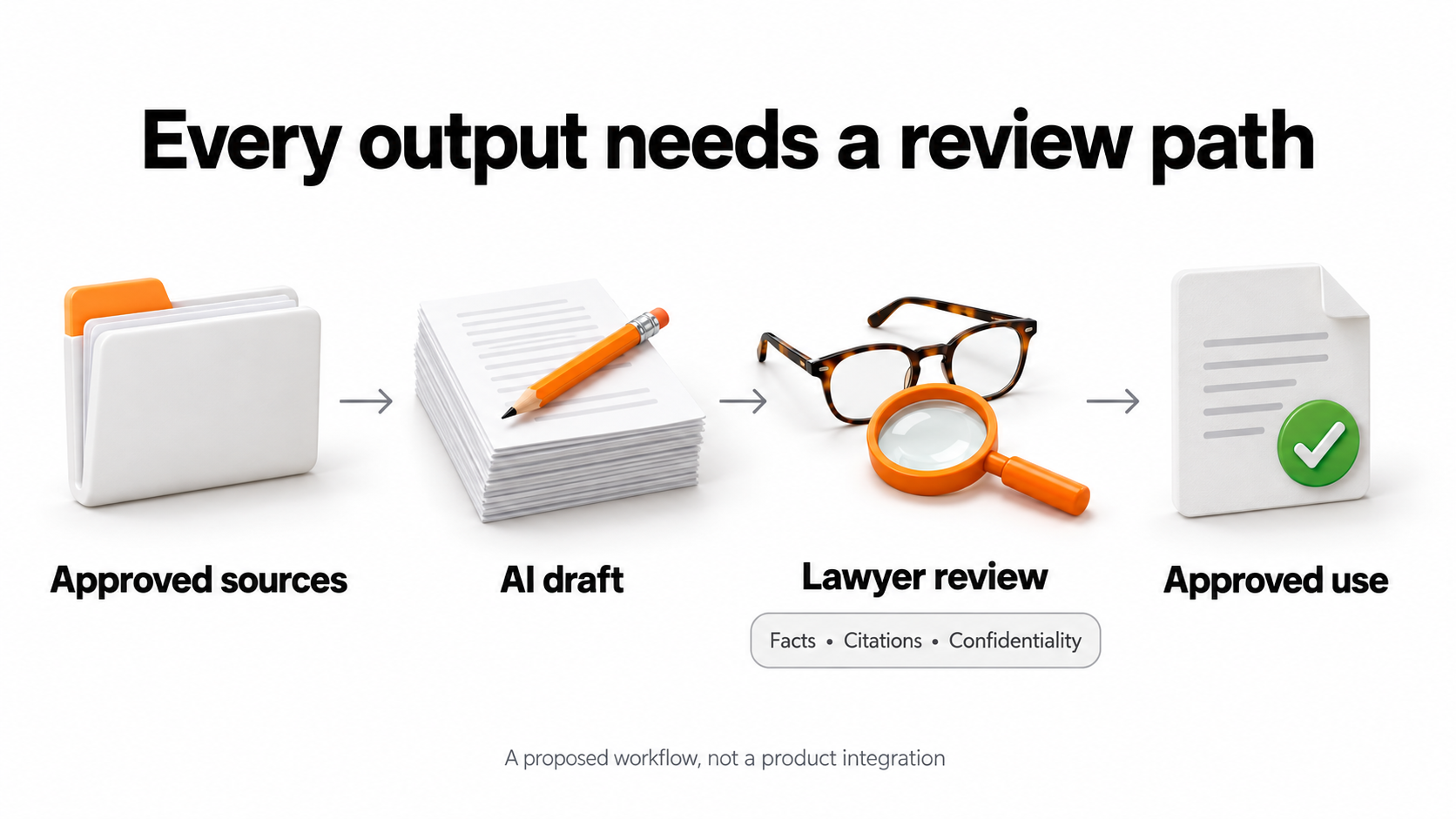
OpenAI's documentation on dot controls describes action review, permissions and optional custom rules. It cautions that instructions can be imperfect and distinguishes draft requests from permission to send. For a first pilot, our recommendation is a draft-only process with no authority to send, publish or change a matter record.
Give staff a visible status sequence such as needs review, approved for a named use and completed by an authorized person. Record the version that was approved. If a draft callback message changes, the old approval should not carry over automatically. If the recipient changes, check the message again before it leaves the firm.
Specify where the report goes and when the pilot ends. Use the actual office's time zone rather than writing only “Texas time.” Choose the review cadence according to staff coverage. An unattended report delivered after staff leave may create the appearance of a managed queue without anyone available to act on it.
Provide a fallback owner and a manual queue. If an app connection expires or the source sheet cannot be read, the workflow should surface that failure. Silence must not mean “nothing needs attention.” Test that condition with the fictional set before relying on the report.
Turn approved questions into useful marketing
A reviewed intake trend can suggest a public article, but do not move private messages into a content prompt. Ask the responsible lawyer to approve a general topic first. For example, a Dallas practice might want a clearer explanation of how to request a consultation, while a Houston firm might need a better page explaining the kinds of inquiries it handles. Write from approved public facts.
Our Texas legal content marketing page covers that editorial work. Pair a useful article with the relevant practice page, a working contact route and descriptive internal links. For local implementation, see Dallas law firm SEO and marketing. Do not manufacture a Dallas office, a success story or a credential to make a page sound local.
Before publication, compare claims with the firm's approved advertising standards and current requirements. Our Texas attorney website advertising guide provides related reading. A lawyer should assess the actual advertisement. AI-generated wording does not create an exception to the firm's review process.
Keep the article's title and description specific. Use image captions that identify illustrations, a clear publication date and questions that are answered on the page. Structured data should describe the visible article. It cannot supply missing expertise or make an unsupported statement trustworthy.
Measure whether inquiries reach the right person
For a proposed pilot, track the number of records reviewed, missing-owner exceptions found, exceptions missed, corrections required and staff review time. Record failures even when the final report looks polished. These measures describe a test your firm can run; they are not claims about results achieved by ByteZero or OpenAI.
Once a firm has an approved live process, distinguish inquiry volume from qualified consultations and retained matters. An agent completing a task is an operational event, not a new client. Keep any attribution calculation tied to the firm's actual records and use the minimum data needed for marketing reporting.
Choose the next expansion only after the reviewer can explain why the first task is reliable enough for its intended use. That might mean adding one approved source, a new exception type or another staff reviewer. Broad inbox access is not a necessary next step simply because the first report worked.
For teams managing California content too, our sister brand's California dots and Astra editorial workflow explains source checks, confidentiality and publication review. Law Firm Marketing Texas and California Law Firm SEO are ByteZero brands; the state-specific workflows should be evaluated separately.
Frequently Asked Questions
What is a useful first dots workflow for a Texas firm?
An internal exception report built from fictional intake records is a practical proposed pilot. Test missing owners, incomplete fields and duplicates before considering real inquiries. The report should go to a named staff reviewer.
Can a dot decide whether the firm should accept a case?
Case acceptance, conflicts and legal assessments remain with the responsible people under the firm's approved process. This proposed pilot only organizes administrative information and flags uncertainty; it does not delegate those decisions.
Is Astra for Law available to every Texas firm?
No universal availability is established. OpenAI describes initial access for selected US firms and eligible lawyers or supervised staff. Confirm access directly before depending on the legal configuration in a workflow.
Can staff connect a shared intake inbox immediately?
First have the responsible lawyer and technical owner assess the proposed data flow, account terms, permissions and confidentiality obligations. This guide starts with fictional records and does not recommend connecting a live inbox as the initial test.
How should a firm measure the pilot?
Compare the internal report with an expected answer set. Record missed exceptions, false alarms, corrections and staff review effort. Keep operational task completion separate from qualified consultations, retained matters and marketing results.
Does this guide prove the tools work together?
No. It describes a supervised handoff and a test plan, not a verified product integration or client deployment. Confirm the available tools and permissions, then validate the actual setup before introducing real information.
About this guide: Prepared by the ByteZero SEO Team for Law Firm Marketing Texas. This is educational marketing and operations guidance, not legal advice, a tested software integration or an OpenAI endorsement. AI assisted with preparation and illustration. No attorney review of this article is claimed; a firm's responsible lawyers should evaluate its proposed legal uses.