The free AI toolkit for Texas law firms starts from one question: where does an inquiry lose its owner? Most firms lose them in a few places, such as a missed call that never gets a callback, a web form that arrives without a phone number, and a follow-up that each of three people assumes another has. The toolkit lets a firm test that handoff with fictional records, before anything is connected and before a real inquiry goes near a new tool.
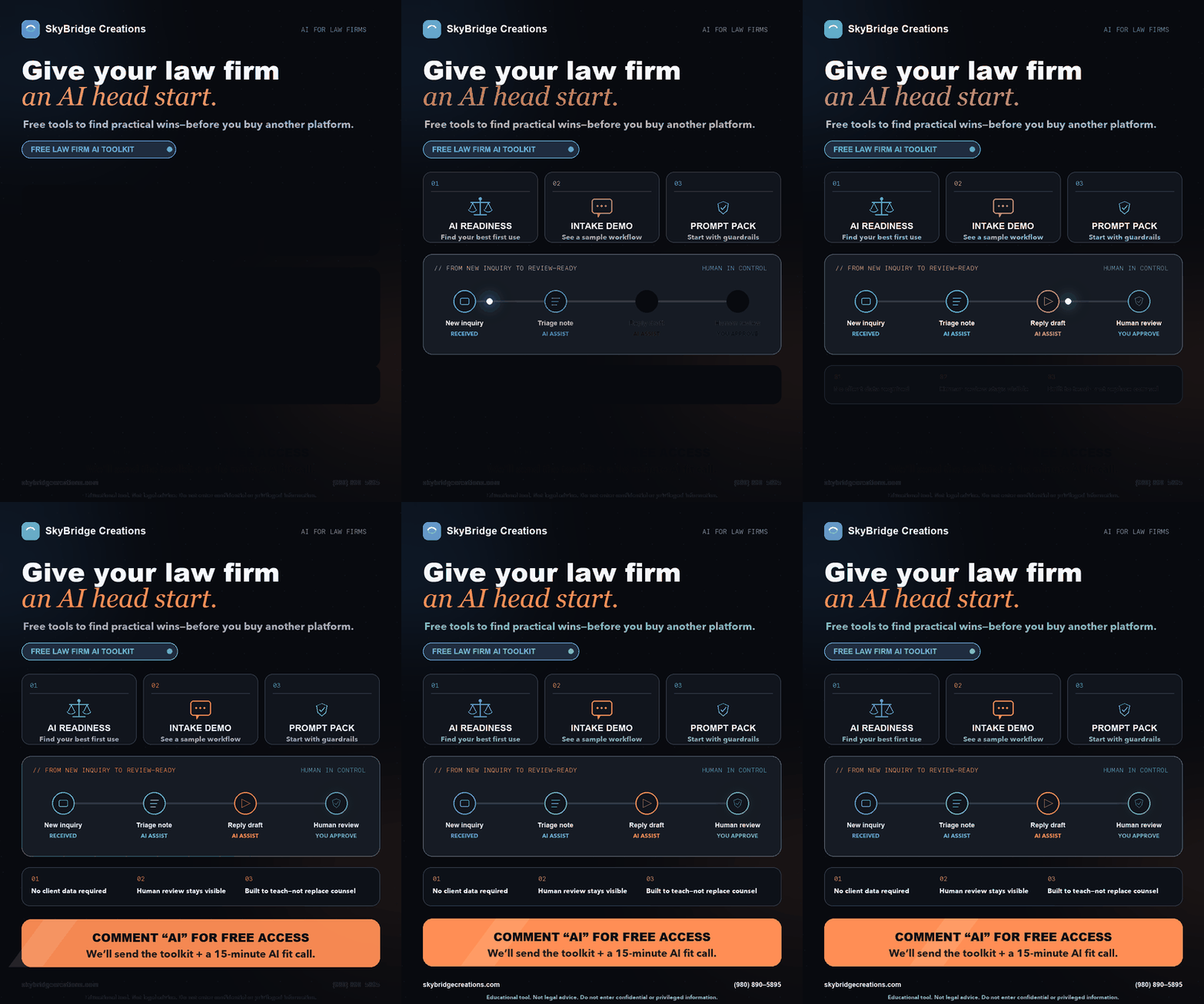
What the free toolkit includes
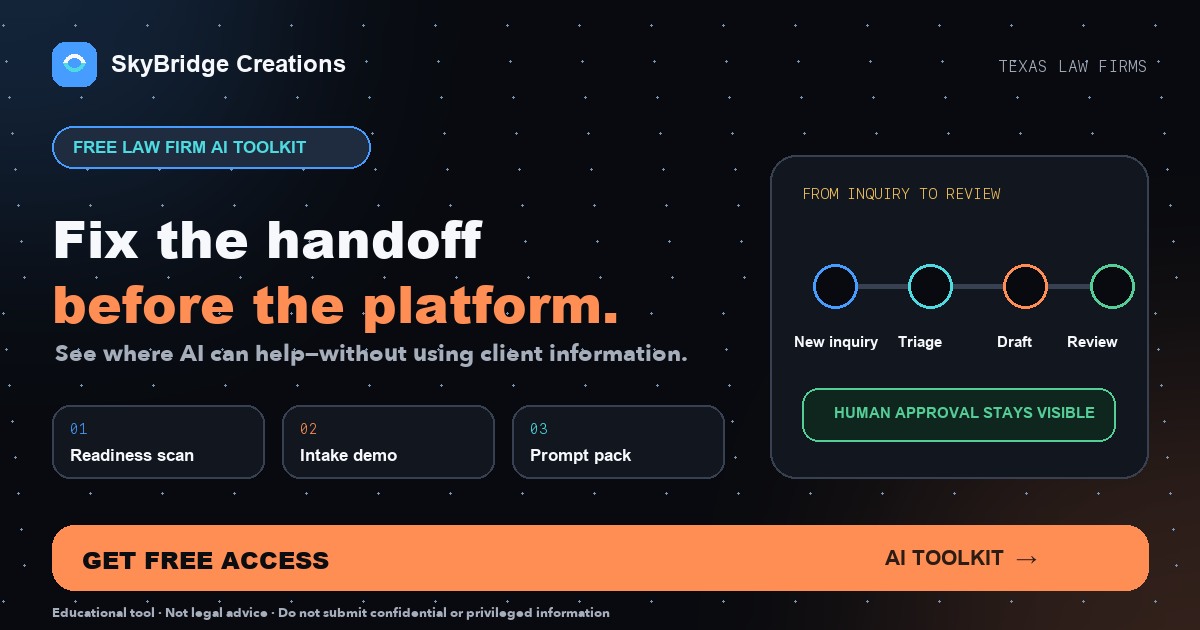
- AI readiness scan. Find one repeatable bottleneck that can be tested without legal judgment.
- Intake handoff demo. Turn fictional missed-call and web-form records into a review list.
- Starter prompt pack. Short instructions that flag missing information and never fill it in.
- Human-review checkpoint. Staff stay responsible for ownership, corrections and every action that leaves the firm.
Which legal AI tools does a Texas firm need first?
Search for the best AI tool for legal help and you get lists that mix research, document review and intake. Those are different jobs, and no single product wins them all. Ask which job you are testing. A firm with an intake problem does not need a legal research engine to find out where records get lost.
Those research products are built for complex legal analysis, so they are a poor fit for a first intake test. OpenAI's Astra for Law is GPT-6 Astra built for professional legal work, with a Legal Search Index that searches U.S. case law and statutes, plus regulations, court rules and administrative decisions. OpenAI says access begins with selected U.S. law firms through Trusted Access and Codex, with the API coming soon. Anthropic's legal artifacts, covered in our Claude legal artifacts guide for Texas firms, sit in a similar place.
Harvey AI is the most visible of the legal AI tools sold to large firms, and its own page says more than 3,500 legal organizations use it. The product list includes a document vault and an intake product, and visitors are pointed to a demo request. There is no price or free plan on that page, so a small Texas firm should ask Harvey directly what an engagement involves.
For this toolkit you need none of them. You are only sorting records and flagging gaps, with no legal analysis or case-law lookup involved.
Which AI tool is totally free, and what does free cost?
Several general-purpose assistants have free plans. Claude's pricing page lists a Free plan at $0, and ChatGPT lists one too. The same pages are the reason to be careful. On the day we checked them (November 5, 2026), Claude's comparison table showed model training as "Opt-out" for its Free plan, and ChatGPT's privacy table showed that on its Free plan content is used to train its models, with an opt-out available. Plans and terms change, so read the current version before you rely on either.
That matters for a lawyer. Texas Ethics Opinion 705, issued in February 2025, says a lawyer should be "reasonably satisfied that the program will not reveal confidential information to others." It lists four precautions: understand how the technology works, review the terms of service, learn how the tool protects data, and train lawyers and staff. It singles out self-learning tools that store what users type as a particular concern. It does not rule out consumer tools, and it does not mention free ones by name.
So a free legal AI chatbot is fine for the toolkit test and the wrong place for a real client's name. The records in the exercise are fictional, which means a free plan costs you nothing in confidentiality. Move to real data only after a lawyer at the firm has read the terms and decided the tool qualifies.
Test the handoff with five fictional records
Make a short test set and plant a problem in each record. Write the expected answer first, then run the exercise and compare. The sheet below shows the shape. Every name in it is invented.
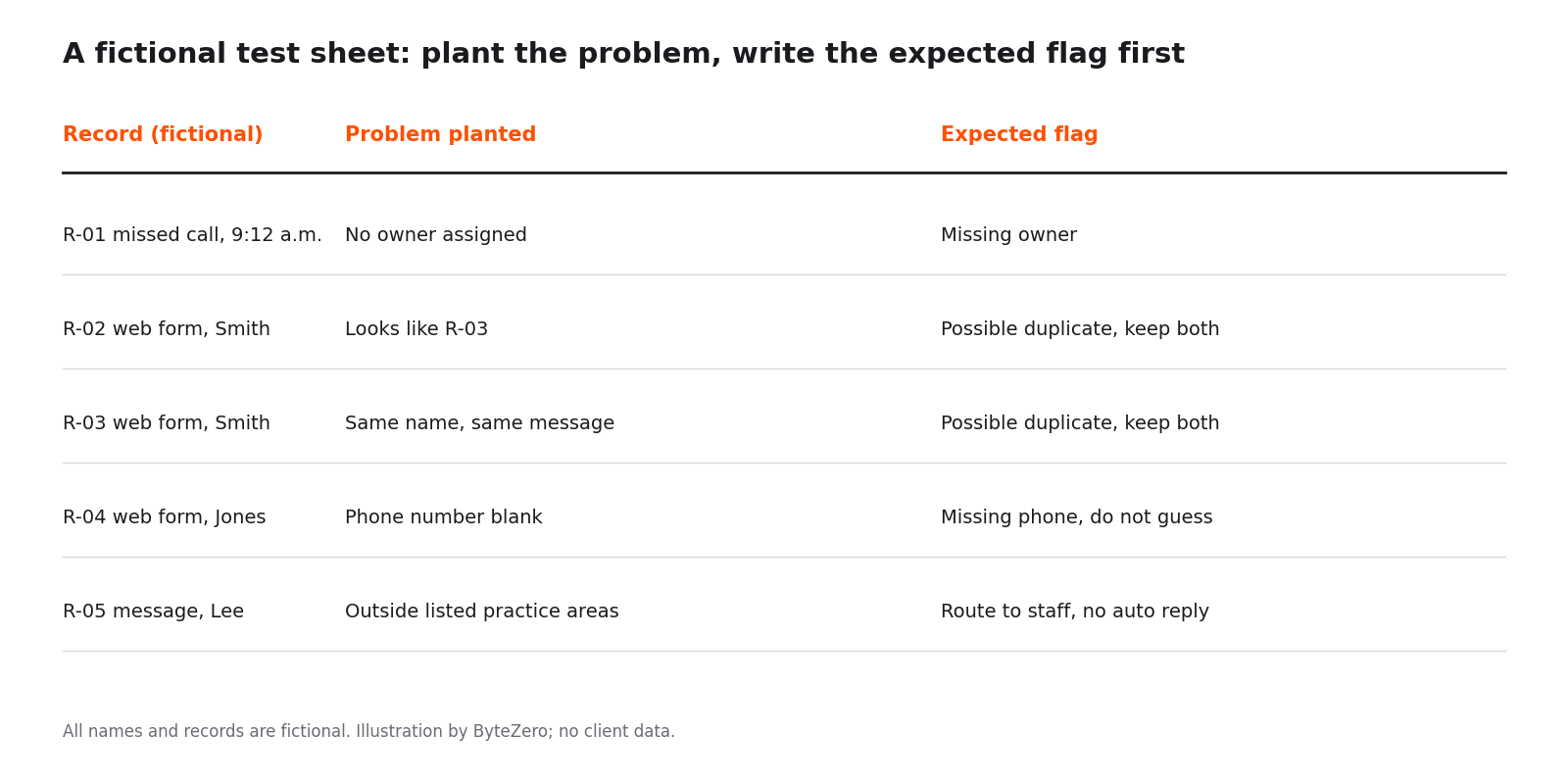
The AI task is to organize the records and say what needs review. It may flag a missing owner, a possible duplicate or an empty field. It has to keep the original text and mark anything it is unsure about. Staff decide whether each flag is right and what happens next.
The two Smith records show why you plant the problem yourself. A model that merges them has lost information, and one that deletes the second has made a decision that was not its to make. The expected answer is "possible duplicate, keep both," and the check is simple: did it say that?
A team in Dallas, Houston or Austin can run this in an afternoon without claiming a local deployment or feeding a live inbox into anything. The market matters little. The test works anywhere that a record can go missing between two people, and the Dallas law firm SEO page shows how the inquiry side of the same problem looks in one large market. If your firm gets most of its inquiries by phone, build more missed-call records into the sheet. If most arrive through the website form, plant more incomplete forms.
What the first test should leave alone
For the first run, keep it simple. Leave the live inbox out, and keep the model away from case merits, representation decisions, deadlines and outgoing messages. Even when the tool produces a polished email, that says nothing about whether the underlying record is correct or whether anyone approved sending it. Opinion 705 says a lawyer should verify the accuracy of any response from a generative AI tool, and the same habit applies to a flag list.
Opinion 705 also speaks to billing. A lawyer may bill hourly for the time actually spent using a tool, including refining and checking its output, but not for time the tool saved. A firm that bills hourly should settle that question before AI changes how long intake and review take.
Score the run like an audit
Measure the test by what staff can verify: what it missed, what it flagged by mistake, what staff had to correct, and how long review took. Suppose the sheet plants five problems and the run flags three. That leaves two misses to explain, and the explanation is usually in the instructions or the source format. Completing more AI tasks is not the same as improving intake.
Keep a one-page note of each run: what was tested, what the AI flagged, what staff corrected and who signed off. That record is what lets a partner decide, a month later, whether the next step is another test or a pause.
If the first test shows that records go missing in your phone system and not in the form, the fix may be a routing rule and not an AI tool at all. A good test is allowed to say that.
A half-day plan a small firm can run
You do not need a project team. In most firms an intake manager, one lawyer and one staff member can run this in a single afternoon, in the order below. The order is our suggestion, not a requirement.
- The intake manager builds the five-record sheet and writes the expected flags before anyone opens an AI tool.
- A lawyer reads the terms of whichever assistant will be used and confirms in writing that only fictional records go in.
- One staff member runs the starter prompt, saves the output untouched and does not fix anything by hand.
- The intake manager and the lawyer compare the output with the sheet, mark each flag right or wrong and note why.
The point of saving the output untouched is to keep the test honest. If someone tidies the result before the comparison, the firm learns about the tidier and not about the tool.
Keep the sheet and the notes. If the firm later tries a second test, for example a different record type or a different assistant, the first sheet becomes the baseline. A change that makes the results worse is easy to spot when the earlier run is written down.
Where the test fits in a marketing plan
An intake problem is also a marketing problem. A firm that pays for traffic and loses the inquiry at the handoff gets no return on the click. Our Texas law firm marketing services page explains how the website, acquisition and intake sides should support one growth plan, and the market pages for Houston and Austin show how that plays out city by city. The firm's lawyers and intake leaders keep every professional and operational decision.
Get the Texas toolkit
Use the contact form and write AI Toolkit in your message. We will send the toolkit and offer an optional 15-minute AI fit call to talk through one repeatable bottleneck. The call is not required for access.
For a companion version focused on choosing a supervised first workflow, see the free AI toolkit for California law firms.
Frequently asked questions
What is the best AI tool for legal help?
It depends on the job. Research tools such as Astra for Law are built for legal analysis, document tools review contracts, and intake tools sort inquiries. For a first intake test you need none of them. Any assistant the firm already has can sort fictional records, and a lawyer should vet anything that will see real client information.
Which AI tool is totally free?
Claude and ChatGPT both list free plans, but free plans can come with data-use terms that differ from paid business plans. Use a free plan only with fictional records, and have a lawyer read the current terms before any client information goes in.
Is there a free legal AI chatbot a law firm can use?
A free general-purpose chatbot can run the toolkit exercise on invented records. It is not a substitute for a legal research product, and Opinion 705 asks lawyers to check confidentiality and terms before using any generative AI tool with client information.
Is Harvey AI free for small Texas firms?
Harvey's product page lists no price or free plan and points visitors to a demo request. A small firm should contact Harvey for current availability and terms.
Can the toolkit decide whether the firm should accept a matter?
No. Case acceptance, conflicts, legal assessments and representation decisions stay with the firm's responsible people and approved process. The toolkit is an educational exercise and does not connect to any case-management, intake or communication system.
Is real client or inquiry data needed?
No. The starter test uses fictional missed-call and web-form records. Do not submit confidential, privileged or identifying information to us or to any AI tool as part of the exercise.
Disclosure: This toolkit is educational and is not legal advice. We claim no client deployment, attorney review, endorsement, compliance finding or software integration. Product and pricing pages were checked on November 5, 2026.